

- Description
- Lesson Schedule
- Class Intro Video
- A Biblical Worldview
- The Lemons-Aid Way
- Teacher Bios
- Outschool
- Request a Section
- Reviews (0)
- Philosophy of Teaching: Science
Description
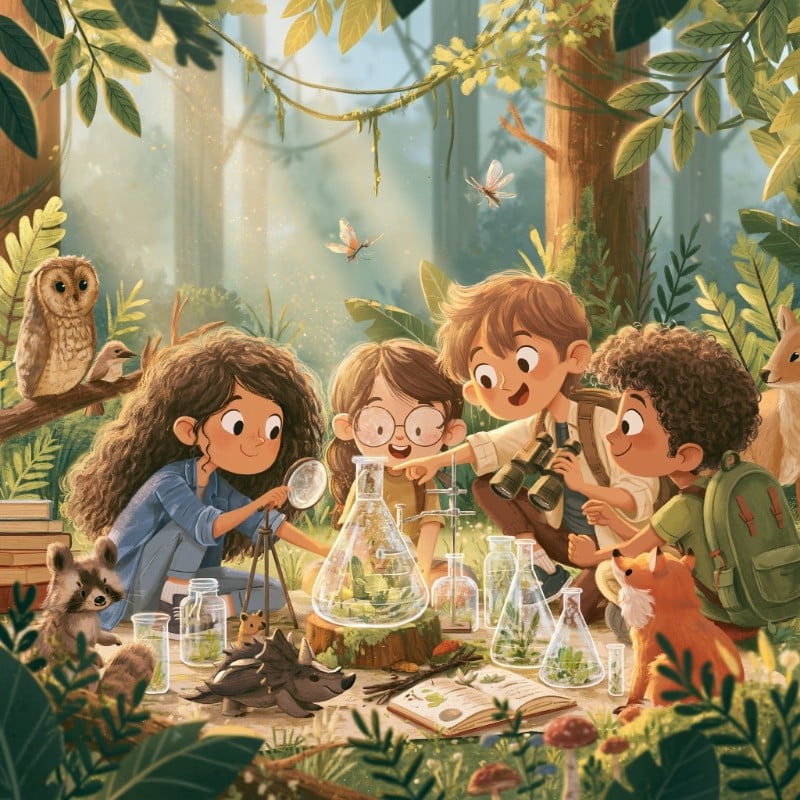
Spark your child’s natural curiosity about the world around them! Designed specifically for young learners in Kindergarten and 1st Grade, Wonder of Science introduces fundamental STEM concepts through high-energy, interactive 25-minute weekly adventures.
Each week, we jump into the pages of non-fiction science books starring classic, beloved characters like the Cat in the Hat! Our short, bite-sized story sessions act as a launching pad for hands-on visual demonstrations, playful discussions, and “at-desk” activities that bring science to life right in your living room
.
Students will explore 10 big scientific topics across four foundational areas:
- 🧬 Life Science: Discover how plants grow, explore animal traits and habitats, examine how our own bodies work, and peek into the fascinating world of insects!
- 🌍 Earth & Space Science: Blast off to explore planets and the Moon, compare the icy Arctic to hot desert sands, and discover how weather shapes our daily lives.
- ⚡ Matter & Energy: Learn how energy powers our world, investigate light and sound, and see how forces like pushes and pulls move things around us.
- 🧱 Structures & Engineering: Uncover how animals build their homes and learn how shapes, strong materials, and foundations help humans build tall towers and sturdy bridges!
Semester A
Book 1: Is a Camel a Mammal?
- Week 1: What Makes a Mammal a Mammal?
- Week 2: Wild Mammal Records!
- Week 3: Oddball Mammals & Adaptations
Book 2: Oh Say Can You Seed?
- Week 4: Seeds & Roots: Going Underground
- Week 5: Stems & Leaves: Sun Catchers
- Week 6: Flowers, Bees, & Pollen
Book 3: Inside Your Outside!
- Week 7: Bone & Muscle Teamwork
- Week 8: The Heart & Engine (Circulation & Digestion)
- Week 9: Our Super Senses
Book 4: There’s No Place Like Space!
- Week 10: The Sun & Inner Planets
- Week 11: Outer Gas Giants & Moons
- Week 12: Day, Night, & The Moon
Book 5: Ice Is Nice!
- Week 13: Living on the Ice (Arctic vs. Antarctica)
- Week 14: Blubber & Fur: Staying Warm
- Week 15: Icebergs, Snow, & Glaciers
Semester B
Book 6: Why Oh Why Are Deserts Dry?
- Week 16: What Makes a Desert?
- Week 17: Desert Plants & Water Savers
- Week 18: Nighttime Creatures (Nocturnal Animals)
Book 7: On Beyond Bugs!
- Week 19: Insect Bodies: The 3-Part Plan
- Week 20: Metamorphosis: Caterpillar to Butterfly
- Week 21: Helpful Insects in Nature
Book 8: Clam-I-Am!
- Week 22: The Ocean Tide Pool
- Week 23: Coral Reefs & Colorful Fish
- Week 24: Deep Sea Wonders
Book 9: Oh, The Things You Can Build!
- Week 25: Shapes in Buildings
- Week 26: Animal Architects
- Week 27: Building Materials & Fasteners
Book 10: Hark! A Shark!
- Week 28: What Makes a Shark Different?
- Week 29: Shark Super Senses & Teeth
- Week 30: Sharks Big & Small
Book 11: Learners Choice!
- Week 31: To be determined
- Week 32: To be determined
Class Introduction Video
Coming soon…
SCIENCE
Our mission is to equip learners’ minds with knowledge of God’s creation. Each lesson features a Bible verse about God’s creation and the lesson topic. This allows students to learn more about the world while ensuring they develop a Biblical worldview. Through learning about and appreciating God’s creation, we learn more about God and grow closer to him. Colossians 1:16, “For by him all things were created, in heaven and on earth, visible and invisible, whether thrones or dominions or rulers or authorities– all things were created through him and for him.” All creation points to God, as Psalm 1:1 says, “The heavens declare the glory of God, and the sky above proclaims his handiwork.”
✨ 🍋 ✨ Why Lemons-Aid? ✨ 🍋 ✨
A BIBLICAL WORLDVIEW: The Bible, infallible and inerrant, is the very written word of God, who has revealed Himself to man. The Bible is like the light we cast on all content areas in order to understand it, whether that be literature, physical science, history, or geometry. Students learn all content through a Biblical lens. Theology is important for understanding all subject areas. We carefully curate courses that capture learners’ imagination while pointing them to God through sound doctrine. THIS is most important!
RICH CONTENT / CORE KNOWLEDGE: While other schools and systems try to align their content to broad standards that are vague and open to wild interpretations, we focus our content on what students should know and be able to do so they see the world biblically and head into their adult lives filled with knowledge, wisdom, and mastery of skill such as computing and writing. For over a century, progressive education reform has been “anti-content,” which means they de-emphasize rich content and focus instructional time on things such as self-esteem and “skills” they hope will benefit a learner in the future. This is why American kids do so poorly in testing compared to nations with content-rich curricula. We want our learners to increase in knowledge and grow in wisdom, which our content-area experts foster while teaching.
EXPLICIT TEACHING: We understand the skills and concepts students need to learn and know how to teach them. Lemons-Aid’s materials are top-notch, organized, and clear for students and parents to understand. We are especially skilled at breaking down a complicated process into understandable parts. Further, explicit instruction is “a structured, systematic, and effective methodology for teaching academic skills. It is called explicit because it is an unambiguous and direct approach to teaching that includes both instructional design and delivery procedures. Explicit instruction is characterized by a series of supports or scaffolds, whereby students are guided through the learning process with clear statements about the purpose and rationale for learning the new skill, clear explanations and demonstrations of the instructional target, and supported practice with feedback until independent mastery has been achieved.”
- Explicit Instruction: Effective and Efficient Teaching by Anita L. Archer and Charles A. Hughes.
Anita Archer trained Mrs. Lemons in workshops, and it changed her teaching. Read a little more about the research behind explicit teaching here and here.
STUDENT ACCOUNTABILITY = ACHIEVEMENT: Students master skills with us and make gains. We have a high degree of accountability. Since we make promises here and parents are paying good money, we understand you trust us to work! Students have to work too, and let’s be honest: they’re kids and don’t always want to. We push it. We teach them how to stay engaged, we cold-call on kids, we tell them to use the chatbox, and we want them to use emojis! If they are resistant, we contact the student through the teacher tab first. If that doesn’t work, we call in the big guns–Mom and Dad. We want kids to learn. We don’t want them to pass through our classes without gaining skills and doing great learning.
DO HARD THINGS. Boost your confidence, master new skills, learn new concepts. This takes a commitment to do hard things. Like the standards we have for our teachers, we also expect our learners to do hard things, whether that means they stand firm in their convictions, learn geometry, write an essay, or give an oral presentation. You can do hard things!
HEALTHY RELATIONSHIPS: To balance our high expectations for their learning and behavior, we build relationships with them. We want them to know we care about and know them. We’ll ask about their play last weekend or the new trick they’re trying to master on the skateboard. We also want students to get to know each other and encourage community engagement.
DEPENDABLE: Multiple teachers are teaching this class, and we have an entire year of lessons planned and scheduled. Since we are a mission-driven organization, we protect our brand and the relationships with our families. We are accountable to our learners. When things come up for teachers, we work to get substitutes and do everything we can before canceling a class. We do not like canceling or changing, and we often teach classes at a loss to give others a chance to join. We have limits, of course, but we are not flippant or irresponsible about canceling! When things come up for students, since we have multiple sections, they can transfer from section to section. All our teachers teach the same content the same week, giving families even more flexibility!
TEACHER FEEDBACK: The back-and-forth work between a student and teacher significantly benefits a student if done well. We follow best practices in designing class time, assignments, and routines. According to Pennington Publishing, effective writing feedback (or grading) is:
- Specific, not general
- Immediate, not postponed
- Routine with a revision / feedback cycle
- Explanatory
- The right amount
- Targeted to the most critical issues
- Varied (written, audio, and video comments)
- Holding students accountable
WORKSHOP TIME: We use “workshop time” so students will work while the teacher answers questions, gets them started, and holds them accountable. In a writing class, the teacher “visits” learners on their Google Documents and watches and helps them write. The immediacy of the feedback/revision cycle with the instructor allows writers to improve rapidly. Additionally, once we started using this method in writing classes, we saw nearly a 100% completion rate in student essays!
GRAPHIC ORGANIZERS: Students need graphic organizers to help them see the structure and breakdown of a concept or process. For example, we use them to help learners understand how to write a paragraph or essay and to use the writing process. This is how they learn to develop coherent ideas. They don’t figure out how to do this magically; the graphic organizers and the intentional, explicit teaching help them learn the skills!
STUDENT MASTERY: Each class includes explicit, direct instruction with teacher modeling. Students are guided toward mastery of skills and understandings to grasp the concepts and become independent. Students are held to a high standard of academic work, including often ignored skills like the use of grammar and neatness in math.
STUDY THE BEAUTIFUL
We are surrounded by the mediocre, which is not good! We see this in expectations at some schools, the poor customer service at a store, and even architecture like in a gray, uninspiring complex of high-occupancy housing.
In contrast, we are surrounded by the beautiful, which is good! We see the beautiful in classic literature, music, and beautiful architecture like pictured here.
The mediocre demoralizes learners while the beautiful inspires.
At Lemons-Aid Learning, we study the beautiful: classic literature, artful sentence construction, art, poetry, maths, God’s hand in all of history, and God’s very creation. His creation glorifies Him, and in our study of all content areas, we learn about who God is.
We do not compromise. This means we don’t choose a graphic novel of Shakespeare’s A Midsummer Night’s Dream. We read the original play. We know how to make the complexity and beauty of classic study approachable and understandable to a modern audience. It’s more difficult, but worth the effort!
CUSTOMER SERVICE
We serve the Lord and we work hard for families. We work to give quick responses to questions, authentic and careful feedback, and to solve any conflict. As home educators ourselves, familiar with the joys and struggles of teaching our own children, we can relate! We are supporting families, equipping learners, and serving Christ. We are 100% devoted to Him and to you!
To read more about our teaching and learning methods, read our blogs, written by our teachers and staff.
The Lemons-Aid Team
Lemons-Aid teachers have a few things in common.
❤️ They love their students and value each of their unique strengths and personalities that make our classes special. Our classes can be described as fun, personal, academic, challenging, and supportive.
🤩 We work to keep learners engaged, so there is always a degree of student accountability for their attention and focus, whether that be through asking them direct questions or by using the chatbox.
💭 We know all kids can learn, but sometimes things are hard! To support students, we teach them how to develop effective thinking and learning habits that will bring them success in class and in life.
🌟 Building relationships with students so they know we care about them helps us balance the high expectations we have for them regarding their effort, work quality, and behavior. Our students are encouraged, cared for, and they achieve!
𝘿𝘼𝙉𝙄𝙀𝙇𝙇𝙀 𝙈𝙊𝙍𝙏𝙄𝙈𝙊𝙍𝙀: Science
#engaging, #passionate, #supportive, #knowledgeable, #dedicated
Danielle’s favorite book of the Bible is any of the books by Paul the Apostle, but her absolute favorite of his writings is the book of Galatians. Paul teaches that we are justified through faith, not by works. Our works should make our faith apparent, but are not what get us to Heaven. So no matter how many times we mess up and drift away from God, it is our faith that justifies us, not what we do. Danielle earned her Bachelor’s of Science in General Biology in 2010, then she went on to earn her Master’s of Science in Curriculum and Instruction in 2020. She is currently certified in grade 6-12 for science and biology. Danielle has worked in a traditional brick and mortar school for 7 years and taught online for 1 year. Most of her experience is in middle school, 6th-8th general science and high school biology. She has also taught conservation biology programs at two different zoos as a coordinator and education assistant. Mrs. Mortimore’s classroom is engaging and fun. Students feel welcomed to ask questions no matter how silly they may seem. Students are also asked questions quite often to encourage participation. Every lesson starts with an overarching question that students will answer, and instruction is hands-on and phenomena based. When Danielle is not working, she is often brainstorming on future lessons/courses. She enjoys reading fantasy fiction, playing videos games with her husband, walking their dog, and attending church.
Christian Teachers on Outschool
Lemons-Aid Coupon Code:
We want to serve you on Lemons-Aid! For first-time learners on Lemons-Aid, you can use the coupon code Newbie20 to get $20 off your first class.
Outschool Coupon Code:
If the schedule on this platform doesn’t work for you, we will happily teach you on Outschool, but we can’t talk about Jesus. Use this referral code and get $20 off your first class on Outschool: LEMONSA2020
Visit Lemons-Aid Learning on

Request a New Section
Want to see this class offered at another time? Send a request, and we’ll see what we can do!
Our mission is to equip learners’ minds with knowledge of God’s creation. Each lesson features a Bible verse about God’s creation and the lesson topic. This allows students to learn more about the world while ensuring they develop a Biblical worldview. Through learning about and appreciating God’s creation, we learn more about God and grow closer to him. Colossians 1:16, “For by him all things were created, in heaven and on earth, visible and invisible, whether thrones or dominions or rulers or authorities– all things were created through him and for him.” All creation points to God, as Psalm 1:1 says, “The heavens declare the glory of God, and the sky above proclaims his handiwork.”
Reviews
There are no reviews yet.