

- Description
- Lesson Schedule
- Class Intro Video
- A Biblical Worldview
- The Lemons-Aid Way
- Teacher Bios
- Outschool
- Request a Section
- Reviews (0)
- Philosophy of Teaching: History
Description
Teenagers can do hard things, including holding their own in a conversation about ancient Rome or the Reformation, drawing a straight line from a Sumerian scribe to the smartphone in their pockets. Picture your teen reading a headline about the Middle East and understanding the centuries-long story behind it and our sovereign God’s hand in it all. This course grows middle schoolers into students who see the modern world as the fruit of six thousand years of choices, cultures, and convictions, and who know where their own place in that long story lies.
God’s Hand in History
Every empire rises and falls under the hand of the same sovereign God. Daniel 2:21 tells us plainly, He removes kings and sets up kings. When we walk through the pharaohs of Egypt, the philosophers of Greece, the Caesars of Rome, the caliphs of the Middle East, and the reformers of Europe, we are not tracing a tangle of accidents. We are watching Providence at work, preparing a world for the coming of Christ, spreading His gospel through Roman roads and Gutenberg’s press, judging pride and blessing humility. This course invites students to see history the way Scripture sees it, as one long, ongoing story authored by a God who keeps His promises across millennia.
Course Content
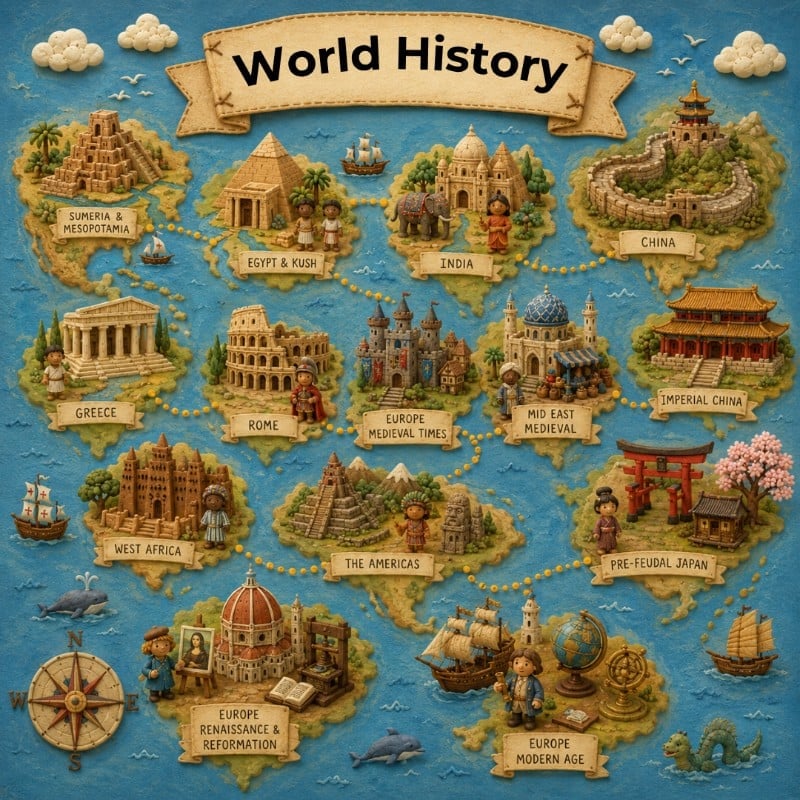
The course unfolds over sixteen units, each anchored by an essential question and grounded in primary sources.
- Unit 1: Foundations of History. Students learn how historians investigate the past, explore the great themes of world history, and study how world religions have shaped human society.
- Unit 2: The Rise of Civilization. Students trace the shift from hunting and gathering to farming, and study the earliest civilizations in Mesopotamia and the Americas.
- Unit 3: Ancient Egypt and Kush. Students meet the pharaohs, walk through daily life along the Nile, and discover the powerful kingdom of Kush.
- Unit 4: Ancient India. Students explore how geography shaped early settlement, uncover the secrets of Mohenjodaro, and study the golden age of the Gupta Empire.
- Unit 5: Ancient China. Students study the geography, the Han dynasty, and the great trade highway of the Silk Road.
- Unit 6: Ancient Greece. Students witness the birth of democracy, compare Athens and Sparta, and trace the legacy Greece left to the modern world.
- Unit 7: Ancient Rome. Students study the Roman Republic, the rise of the Empire, daily life among rich and poor, and the ways Rome still shapes us today.
- Unit 8: Europe During Medieval Times. Students explore feudalism, its decline, and the Byzantine Empire.
- Unit 9: The Middle East During Medieval Times. Students study Muslim innovations, the Crusades, and the empires that rose after.
- Unit 10: The Culture and Kingdoms of West Africa. Students explore early West African societies, the wealthy Ghana Empire, and the cultural legacy that reaches us today.
- Unit 11: Imperial China. Students meet the civil-service scholars, marvel at medieval Chinese inventions, and study China’s contacts with the outside world.
- Unit 12: Pre-Feudal Japan. Students learn how neighboring cultures shaped Japan, and step into the golden age of Heian-kyo.
- Unit 13: Civilizations of the Americas. Students study the Maya, the Aztecs, and the Incas.
- Unit 14: The Medieval World, 1200-1490. Students follow the sweeping Mongol Empire and the trade routes that increasingly connected Afroeurasia.
- Unit 15: Europe’s Renaissance and Reformation. Students witness the rebirth of art and learning in Florence, and study the factors that led to the Reformation.
- Unit 16: Europe Enters the Modern Age. Students explore the Age of Exploration, the Scientific Revolution, and the Enlightenment ideas that shaped modern government.
A Snapshot of a Live Class
Every live class follows the same steady rhythm. We open with a welcome, prayer, and a look at the day’s essential question, orienting students to the story they are about to enter. Direct instruction comes next, the teacher guiding students through the day’s big idea using maps, primary sources, images, videos, and short readings. Students participate in historical simulations, discussions, and interactive activities do deepen their understanding and demonstrate learning.
Between the Live Classes
Between live classes, learners work through homework, creating a project that demonstrates learning, writing an essay, or completing an interactive lesson online.
- Unit 1: Foundations of History. Students learn how historians investigate the past, explore the great themes of world history, and study how world religions have shaped human society.
- Unit 2: The Rise of Civilization. Students trace the shift from hunting and gathering to farming, and study the earliest civilizations in Mesopotamia and the Americas.
- Unit 3: Ancient Egypt and Kush. Students meet the pharaohs, walk through daily life along the Nile, and discover the powerful kingdom of Kush.
- Unit 4: Ancient India. Students explore how geography shaped early settlement, uncover the secrets of Mohenjodaro, and study the golden age of the Gupta Empire.
- Unit 5: Ancient China. Students study the geography, the Han dynasty, and the great trade highway of the Silk Road.
- Unit 6: Ancient Greece. Students witness the birth of democracy, compare Athens and Sparta, and trace the legacy Greece left to the modern world.
- Unit 7: Ancient Rome. Students study the Roman Republic, the rise of the Empire, daily life among rich and poor, and the ways Rome still shapes us today.
- Unit 8: Europe During Medieval Times. Students explore feudalism, its decline, and the Byzantine Empire.
- Unit 9: The Middle East During Medieval Times. Students study Muslim innovations, the Crusades, and the empires that rose after.
- Unit 10: The Culture and Kingdoms of West Africa. Students explore early West African societies, the wealthy Ghana Empire, and the cultural legacy that reaches us today.
- Unit 11: Imperial China. Students meet the civil-service scholars, marvel at medieval Chinese inventions, and study China’s contacts with the outside world.
- Unit 12: Pre-Feudal Japan. Students learn how neighboring cultures shaped Japan, and step into the golden age of Heian-kyo.
- Unit 13: Civilizations of the Americas. Students study the Maya, the Aztecs, and the Incas.
- Unit 14: The Medieval World, 1200-1490. Students follow the sweeping Mongol Empire and the trade routes that increasingly connected Afroeurasia.
- Unit 15: Europe’s Renaissance and Reformation. Students witness the rebirth of art and learning in Florence, and study the factors that led to the Reformation.
- Unit 16: Europe Enters the Modern Age. Students explore the Age of Exploration, the Scientific Revolution, and the Enlightenment ideas that shaped modern government.
Class Introduction Video
Coming soon…
Taught From a Christian Perspective
Our mission is to equip learners’ minds and shepherd their hearts. We want them to have saving faith in our Lord Jesus Christ and then develop a biblical worldview. This means they view their world, themselves, and God in a way that aligns with what the Bible teaches. This brings great peace and understanding to the believer because we serve a good, sovereign God. This course is taught with these goals in mind. In class, we may pray, read scripture, and discuss how to view the content from a Christian perspective.
We have adopted The Master’s Seminary Doctrinal Statement.
✨ 🍋 ✨ Why Lemons-Aid? ✨ 🍋 ✨
A BIBLICAL WORLDVIEW: The Bible, infallible and inerrant, is the very written word of God, who has revealed Himself to man. The Bible is like the light we cast on all content areas in order to understand it, whether that be literature, physical science, history, or geometry. Students learn all content through a Biblical lens. Theology is important for understanding all subject areas. We carefully curate courses that capture learners’ imagination while pointing them to God through sound doctrine. THIS is most important!
RICH CONTENT / CORE KNOWLEDGE: While other schools and systems try to align their content to broad standards that are vague and open to wild interpretations, we focus our content on what students should know and be able to do so they see the world biblically and head into their adult lives filled with knowledge, wisdom, and mastery of skill such as computing and writing. For over a century, progressive education reform has been “anti-content,” which means they de-emphasize rich content and focus instructional time on things such as self-esteem and “skills” they hope will benefit a learner in the future. This is why American kids do so poorly in testing compared to nations with content-rich curricula. We want our learners to increase in knowledge and grow in wisdom, which our content-area experts foster while teaching.
EXPLICIT TEACHING: We understand the skills and concepts students need to learn and know how to teach them. Lemons-Aid’s materials are top-notch, organized, and clear for students and parents to understand. We are especially skilled at breaking down a complicated process into understandable parts. Further, explicit instruction is “a structured, systematic, and effective methodology for teaching academic skills. It is called explicit because it is an unambiguous and direct approach to teaching that includes both instructional design and delivery procedures. Explicit instruction is characterized by a series of supports or scaffolds, whereby students are guided through the learning process with clear statements about the purpose and rationale for learning the new skill, clear explanations and demonstrations of the instructional target, and supported practice with feedback until independent mastery has been achieved.”
- Explicit Instruction: Effective and Efficient Teaching by Anita L. Archer and Charles A. Hughes.
Anita Archer trained Mrs. Lemons in workshops, and it changed her teaching. Read a little more about the research behind explicit teaching here and here.
STUDENT ACCOUNTABILITY = ACHIEVEMENT: Students master skills with us and make gains. We have a high degree of accountability. Since we make promises here and parents are paying good money, we understand you trust us to work! Students have to work too, and let’s be honest: they’re kids and don’t always want to. We push it. We teach them how to stay engaged, we cold-call on kids, we tell them to use the chatbox, and we want them to use emojis! If they are resistant, we contact the student through the teacher tab first. If that doesn’t work, we call in the big guns–Mom and Dad. We want kids to learn. We don’t want them to pass through our classes without gaining skills and doing great learning.
DO HARD THINGS. Boost your confidence, master new skills, learn new concepts. This takes a commitment to do hard things. Like the standards we have for our teachers, we also expect our learners to do hard things, whether that means they stand firm in their convictions, learn geometry, write an essay, or give an oral presentation. You can do hard things!
HEALTHY RELATIONSHIPS: To balance our high expectations for their learning and behavior, we build relationships with them. We want them to know we care about and know them. We’ll ask about their play last weekend or the new trick they’re trying to master on the skateboard. We also want students to get to know each other and encourage community engagement.
DEPENDABLE: Multiple teachers are teaching this class, and we have an entire year of lessons planned and scheduled. Since we are a mission-driven organization, we protect our brand and the relationships with our families. We are accountable to our learners. When things come up for teachers, we work to get substitutes and do everything we can before canceling a class. We do not like canceling or changing, and we often teach classes at a loss to give others a chance to join. We have limits, of course, but we are not flippant or irresponsible about canceling! When things come up for students, since we have multiple sections, they can transfer from section to section. All our teachers teach the same content the same week, giving families even more flexibility!
TEACHER FEEDBACK: The back-and-forth work between a student and teacher significantly benefits a student if done well. We follow best practices in designing class time, assignments, and routines. According to Pennington Publishing, effective writing feedback (or grading) is:
- Specific, not general
- Immediate, not postponed
- Routine with a revision / feedback cycle
- Explanatory
- The right amount
- Targeted to the most critical issues
- Varied (written, audio, and video comments)
- Holding students accountable
WORKSHOP TIME: We use “workshop time” so students will work while the teacher answers questions, gets them started, and holds them accountable. In a writing class, the teacher “visits” learners on their Google Documents and watches and helps them write. The immediacy of the feedback/revision cycle with the instructor allows writers to improve rapidly. Additionally, once we started using this method in writing classes, we saw nearly a 100% completion rate in student essays!
GRAPHIC ORGANIZERS: Students need graphic organizers to help them see the structure and breakdown of a concept or process. For example, we use them to help learners understand how to write a paragraph or essay and to use the writing process. This is how they learn to develop coherent ideas. They don’t figure out how to do this magically; the graphic organizers and the intentional, explicit teaching help them learn the skills!
STUDENT MASTERY: Each class includes explicit, direct instruction with teacher modeling. Students are guided toward mastery of skills and understandings to grasp the concepts and become independent. Students are held to a high standard of academic work, including often ignored skills like the use of grammar and neatness in math.
STUDY THE BEAUTIFUL
We are surrounded by the mediocre, which is not good! We see this in expectations at some schools, the poor customer service at a store, and even architecture like in a gray, uninspiring complex of high-occupancy housing.
In contrast, we are surrounded by the beautiful, which is good! We see the beautiful in classic literature, music, and beautiful architecture like pictured here.
The mediocre demoralizes learners while the beautiful inspires.
At Lemons-Aid Learning, we study the beautiful: classic literature, artful sentence construction, art, poetry, maths, God’s hand in all of history, and God’s very creation. His creation glorifies Him, and in our study of all content areas, we learn about who God is.
We do not compromise. This means we don’t choose a graphic novel of Shakespeare’s A Midsummer Night’s Dream. We read the original play. We know how to make the complexity and beauty of classic study approachable and understandable to a modern audience. It’s more difficult, but worth the effort!
CUSTOMER SERVICE
We serve the Lord and we work hard for families. We work to give quick responses to questions, authentic and careful feedback, and to solve any conflict. As home educators ourselves, familiar with the joys and struggles of teaching our own children, we can relate! We are supporting families, equipping learners, and serving Christ. We are 100% devoted to Him and to you!
To read more about our teaching and learning methods, read our blogs, written by our teachers and staff.
The Lemons-Aid Team
Lemons-Aid teachers have a few things in common.
❤️ They love their students and value each of their unique strengths and personalities that make our classes special. Our classes can be described as fun, personal, academic, challenging, and supportive.
🤩 We work to keep learners engaged, so there is always a degree of student accountability for their attention and focus, whether that be through asking them direct questions or by using the chatbox.
💭 We know all kids can learn, but sometimes things are hard! To support students, we teach them how to develop effective thinking and learning habits that will bring them success in class and in life.
🌟 Building relationships with students so they know we care about them helps us balance the high expectations we have for them regarding their effort, work quality, and behavior. Our students are encouraged, cared for, and they achieve!
𝙆𝘼𝙍𝙀𝙉 𝙇𝙀𝙈𝙊𝙉𝙎: English Language Arts
#High-Energy #Skilled #Experienced #Relational #Fun #Faithful
Karen is the Founder of Lemons-Aid. She has a bachelor’s degree in English, a minor in Education, and a master’s degree in Education Administration from Liberty University. With a teaching certificate and a principal’s license in both Washington and Colorado, she has many years of experience teaching English Language Arts and History / Social Studies at the middle school and high school levels. Additionally, she is TESOL and TEFL certified and enjoys teaching English Language Learners from all over the world. She has worked in private and public schools at every level and is currently an affiliate faculty member at Colorado Christian University, supervising teacher candidates in their undergraduate and graduate teacher education programs. She is a teacher of teachers. A homeschool mom herself, she admits that teaching other people’s kids is easier than teaching her own teenage boys! She lives in the Denver, Colorado area where she cheers on the Broncos, Avs, and the Rockies, but her favorite athletes are her own kids who play hockey and baseball!
Christian Teachers on Outschool
Lemons-Aid Coupon Code:
We want to serve you on Lemons-Aid! For first-time learners on Lemons-Aid, you can use the coupon code Newbie20 to get $20 off your first class.
Outschool Coupon Code:
If the schedule on this platform doesn’t work for you, we will happily teach you on Outschool, but we can’t talk about Jesus. Use this referral code and get $20 off your first class on Outschool: LEMONSA2020
Visit Lemons-Aid Learning on

Request a New Section
Want to see this class offered at another time? Send a request, and we’ll see what we can do!
SOCIAL STUDIES (history, government, economics):
The world of social studies is filled with ideas, some from the recent past and some that reach back millennia. No matter where an idea originates, we as Christians are commanded to take those ideas captive, test them, and compare them to the Word of God to see if they can stand up to the scrutiny of truth (2 Corinthians 10:5, 1 John 4:1, and Acts 17:11). In our social studies classes, we use the Socratic method to encourage and equip students to capture, test, and scrutinize the ideas they encounter.
In history, we encounter new ideas and study how those ideas have influenced the course of human events both for good and for evil. We see how different cultures and belief systems (such as Islam, Buddhism, and Hinduism) address the issues of human origin, identity, meaning, morality, and destiny, and we hold the answers each one presents up to the light of Scripture to see if there is any fault in them. By studying the effects of sin on human history (war, slavery, discrimination, and more), we learn to value human life, because every person who has ever lived reflects the image of God (Genesis 1:26).
In government and economics, we discover that God infused all of creation with a healthy structure for human life and flourishing, concepts known as natural law and natural rights. We contrast these ideas and Scripture itself with humanistic ideas (such as Marxism) that short-circuit God’s design and result in human suffering. Studying these ideas equips students with the tools they need to live as responsible, Christlike citizens and to make sound, biblically based decisions in the civic and economic realms.
Reviews
There are no reviews yet.